
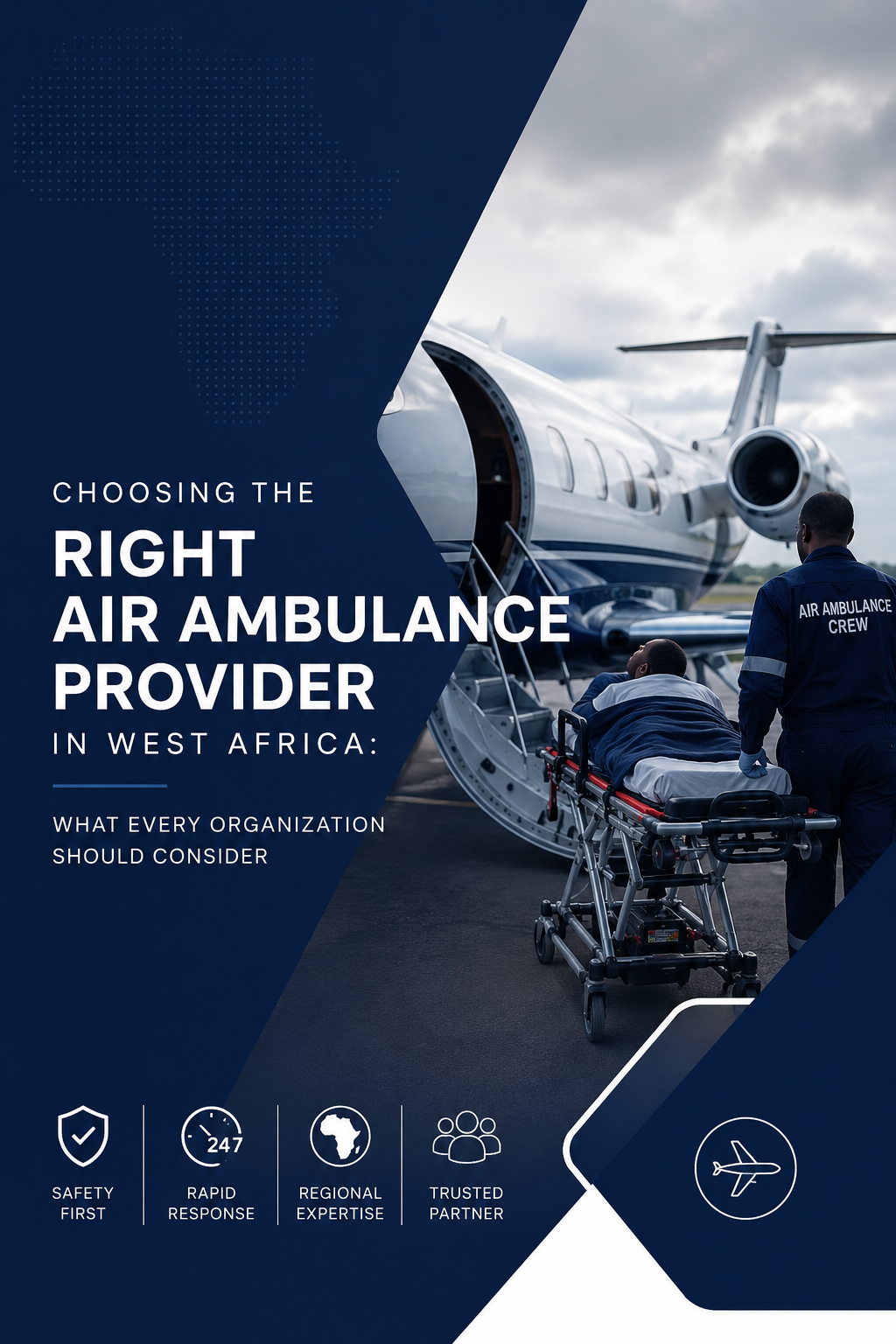
Medical emergencies are stressful enough without having to question whether your chosen evacuation provider can deliver when it matters most.
In West Africa, where vast distances, limited specialist healthcare in some locations, complex aviation regulations, and challenging operating environments are common, selecting the right air ambulance partner is about far more than simply finding an aircraft. It is about choosing an organization capable of coordinating a safe, timely, and seamless medical response from bedside to definitive care.
Here are eight key considerations to evaluate before engaging an air ambulance provider.
1. Regional Operational Experience Matters
West Africa presents unique logistical challenges, from remote project sites and offshore installations to cross-border evacuations requiring multiple regulatory approvals.
A provider with proven operational experience in the region is often better equipped to navigate local complexities, coordinate effectively with authorities, and anticipate potential delays.
Ask yourself:
- How long has the provider operated in West Africa?
- Do they regularly coordinate missions within the region?
- Can they demonstrate experience managing complex cross-border evacuations?
2. Medical Expertise Should Match Patient Needs
Not every patient requires the same level of medical support.
The provider should be able to deploy appropriately qualified clinical teams based on the patient’s condition, whether that involves a physician, critical care nurse, paramedic, neonatal specialist, or another specialist.
Equally important is access to advanced life-support equipment and the ability to deliver intensive care throughout the journey.
3. Response Is About More Than Aircraft Availability
One of the biggest misconceptions is that air ambulance response begins when the aircraft takes off.
In reality, a successful evacuation starts much earlier and involves:
- Clinical assessment
- Flight planning
- Regulatory approvals
- Ground ambulance coordination
- Hospital acceptance
- Family and stakeholder communication
An experienced provider coordinates all these elements as a single, integrated operation.
4. Regional Networks Make a Difference
Medical evacuations often require collaboration with hospitals, aviation authorities, handling agents, ground ambulance providers, and healthcare professionals across multiple countries.
Providers with well-established regional networks can usually mobilise resources more efficiently and coordinate smoother patient transfers.
5. Consider the Provider’s Coordination Capability
A medical evacuation is rarely a standalone flight.
Look for organisations that can provide:
- 24/7 operations centre
- Medical assistance coordination
- Hospital liaison
- Ground transportation
- Commercial medical escort options
- International repatriation support where required
The stronger the coordination capability, the more seamless the patient journey is likely to be.
6. Understand How They Operate in Challenging Environments
Many evacuations in West Africa originate from:
- Offshore platforms
- Mining operations
- Construction projects
- Rural communities
- Border regions
- Humanitarian settings
Ask how the provider manages missions from remote or geographically challenging locations and whether they have experience supporting operations in these environments.
7. Regulatory Knowledge Is Essential
Cross-border medical evacuations involve far more than arranging a flight.
A competent provider should be familiar with:
- Overflight and landing permits
- Airport coordination
- Immigration requirements
- International patient transfers
- Healthcare regulations across different jurisdictions
Strong regulatory expertise helps minimize delays during time-critical missions.
8. Look Beyond the Flight
The best air ambulance providers don’t simply transport patients—they coordinate continuity of care.
This includes:
- Bedside medical assessment
- Stabilization before departure
- Continuous care during transport
- Communication with receiving hospitals
- Safe clinical handover on arrival
Ultimately, the objective isn’t just moving a patient—it’s ensuring they arrive safely and in the best possible condition.
Executive Self-Assessment
Before selecting an air ambulance provider, ask these questions:
✓ Do they have extensive operational experience across West Africa?
✓ Can they coordinate complex cross-border medical evacuations?
✓ Do they provide both clinical care and operational coordination?
✓ Are they experienced in supporting remote and offshore operations?
✓ Can they demonstrate a strong regional healthcare and aviation network?
✓ Do they offer 24/7 emergency coordination?
If you cannot confidently answer “yes” to most of these questions, it may be worth exploring additional providers before an emergency occurs.
How Flying Doctors Nigeria Supports Organizations
With nearly two decades of experience, Flying Doctors Nigeria has coordinated complex medical evacuations and emergency medical responses across West Africa and the broader African region. Our capabilities span fixed-wing air ambulance services, helicopter medical evacuation, commercial medical escorts, ground ambulance support, medical assistance coordination, and remote site emergency response. By combining regional expertise, an extensive partner network, and 24/7 operational coordination, we help organizations ensure their people have timely access to life-saving medical care—wherever operations take them.