
When travelling internationally, we often think about the opportunities that lie ahead, family reunions, new experiences and adventures. Rarely do we imagine how quickly plans can change when a medical emergency arises, and how complex it can be to organize safe medical transport across continents.
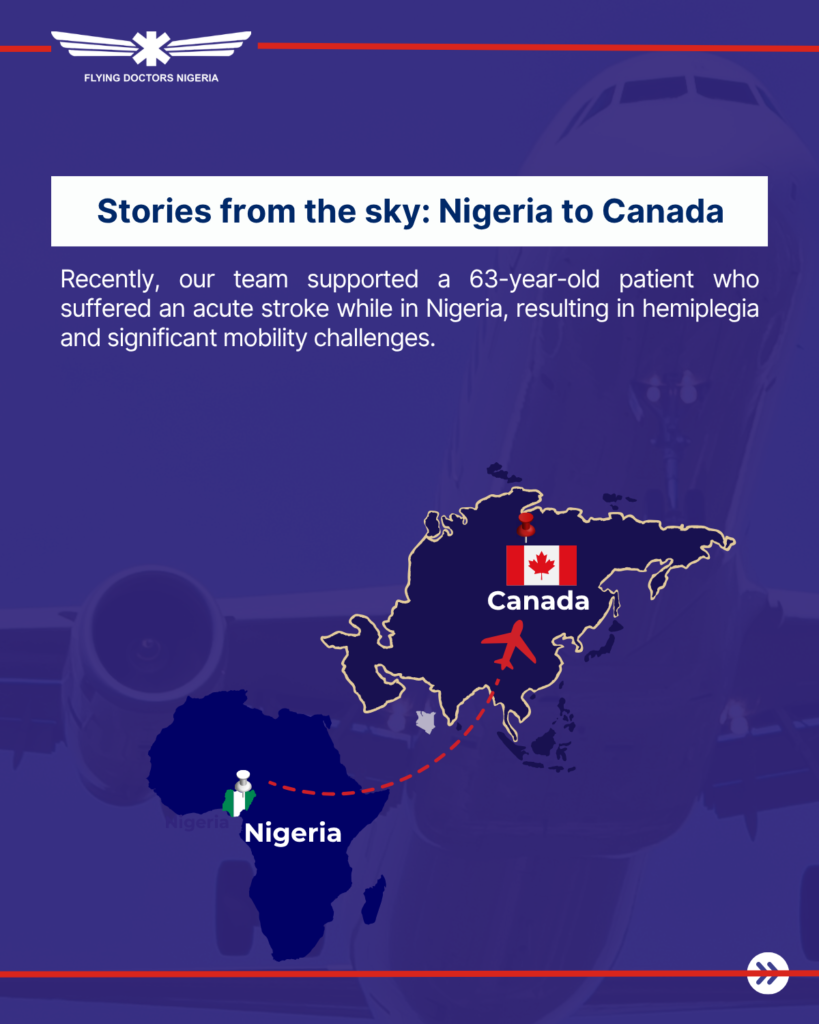
This was the reality of a 63-year-old patient who suddenly suffered a serious neurological emergency while in Nigeria. The patient developed an acute stroke with hemiplegia, experienced significant mobility limitations, and required continued specialized medical attention to support recovery.
Consequently, our team was contacted immediately to assist with arranging a medical evacuation on a commercial flight to Canada. Following this request, we initiated the necessary clinical and logistical arrangements to facilitate timely access to the appropriate level of care. Our team immediately began gathering the patient’s medical information and assessing the feasibility of an international transfer. The initial clinical report indicated that the patient was stable but had significant mobility limitations, the patient was unable to walk, although could sit and had been catheterized for ongoing medical management.
Working closely with the treating physicians, we conducted a comprehensive medical assessment to determine possible modes of transport. Given the patient’s ability to tolerate a seated position and the overall stability of his condition, a commercial medical escort was considered. Our medical team reviewed the patient’s imaging, medication regimen, and neurological status to ensure that the transfer could be conducted safely.
From a logistics perspective, careful planning was required to ensure a seamless journey. Our coordination team liaised with the ticketing correspondent to secure appropriate seating arrangements that would provide adequate space and comfort for the patient, while also facilitating access for the accompanying medical escort. Ground ambulance transfers were organized at both ends of the journey to ensure continuity of care. In addition, we ensured that all necessary medical documentation, clearances, and travel approvals were in place ahead of departure.
On the day of travel, the patient was accompanied by an experienced medical professional equipped with essential medications and monitoring equipment required for in-flight care. The patient was closely monitored throughout the journey, with regular assessments of neurological status, vital signs, and overall comfort. Particular attention was given to preventing complications such as pressure injuries, dehydration, and circulation issues during the long-haul flight.
Thanks to the detailed preparation and close coordination between medical and logistics teams, the transfer proceeded smoothly. The patient remained stable throughout the journey, and the trip was uneventful. Upon arrival in Canada, the patient was safely handed over to the receiving medical team for continued care and rehabilitation.
This case highlights how thoughtful coordination, clinical expertise, and careful logistical planning can make it possible to safely move patients across great distances when they need it most. Behind every successful transfer is a team working quietly but diligently to ensure that patients and their families receive the support they need during some of life’s most challenging moments.
For more information or assistance, please contact us @ emergency@flyingdoctorsnigeria.com.